
 Layne Liddicut is a junior writer and feminist who would quite like equal pay to stop being a fucking debate.
We have rights, laws and equality on paper. So why do the numbers keep telling a different story?
Content note: This article discusses domestic, family and sexual violence, homicide and barriers to healthcare and justice.
Whenever women talk about inequality, someone inevitably points out how lucky we are to live in Australia. We have rights. We have opportunities. What more could we possibly want? Do women really have it that bad here?
Bad compared to what, exactly?
If the benchmark is a woman living under a regime that bans girls from school, then no. Congratulations, Australia. You’ve cleared a bar so low it’s practically a trip hazard. But that was never the right question. The right question is whether Australian women enjoy equal safety, opportunity, autonomy, economic security and access to justice compared with Australian men.
So let’s put the claim that we’ve already “achieved equality” on trial. Human rights are the standard. Let’s put the evidence to the test.
“But women have equal rights here”
Fair enough. On paper, at least. Women can vote, work, own property, study, divorce, start businesses and sit in Parliament. Sex discrimination is unlawful. We have national strategies on domestic and family violence and workplace protections that earlier generations of women fought like hell to win. That progress is real, and it deserves respect.
But having a right written into law doesn’t mean it is protected in real life. Australia lacks a comprehensive federal Human Rights Act. Different laws and jurisdictions provide protections, but no single national framework unites these rights. The Australian Human Rights Commission’s 2026 assessment still calls for such a law. This doesn’t mean women don’t have any enforceable rights. Instead, the protection you have, and how you can use it, depends on which right is involved and where you live. For more information, visit humanrights.gov.au.
A law that says you’re equal does little if the systems around you keep producing unequal outcomes.
Legal equality is the starting line. Substantive equality is the finish. We’re still jogging.
The right to live free from violence
Image credit –
This is the big one, so let’s not tiptoe around it.
The ABS Personal Safety Survey for 2021–22 estimated that 23% of women—around 2.3 million—had experienced physical or sexual violence by an intimate partner since age 15, compared with 7.3% of men. Intimate partners include current and former partners, as well as boyfriends, girlfriends and dates. The same survey found 22% of women had experienced sexual violence since age 15, compared with 6.1% of men. These estimates concern adults aged 18 and over; sexual violence includes sexual assault and sexual threats. Australian Bureau of Statistics
Those are survey estimates of what people experience, including violence that never reaches police. That distinction matters. According to AIHW’s analysis of the survey, only 7.7% of women who experienced sexual assault by a male in the ten years before 2021–22 contacted police themselves about the most recent incident. That’s a specific measure, rather than a percentage of every assault ever committed. But it tells us a lot about what remains outside police records. Australian Institute of Health and Welfare
Then there’s the end. In 2024–25, 32 women were killed by a current or former intimate partner in Australia—an average of one woman every 11 days, according to the National Homicide Monitoring Program figures reported by AIHW. This counts intimate partner homicides, rather than every killing of a woman. Behind each number is a person whose life was taken. Death-review research shows many intimate partner homicides are preceded by abuse and identifiable warning signs. Australian Institute of Health and Welfare
It would be dishonest to pretend nothing has improved. The female intimate partner homicide victimisation rate fell from 0.95 per 100,000 in 1989–90 to 0.29 in 2024–25. That’s meaningful progress. But “better than 1990” isn’t a gold medal. A decline in one lethal form of violence doesn’t tell us that sexual violence, coercive control, stalking or harassment has been solved. Australian Institute of Health and Welfare
And the risk isn’t spread evenly. In 2024–25, the age-standardised rate of family-violence hospitalisations for First Nations females was 26 times the rate for non-Indigenous females, according to AIHW. These are hospitalisations, which can include repeat admissions, rather than a count of individual women. Australian Institute of Health and Welfare
The intimate partner homicide rate for First Nations women also rose from 1.56 per 100,000 in 2022–23 to 3.85 in 2024–25, with deaths increasing from five to thirteen. AIHW cautions that rates based on fewer than twenty deaths can fluctuate substantially. That matters when interpreting the change. It doesn’t make the lives lost any less significant. Australian Institute of Health and Welfare
Women with disability, migrant and refugee women, LGBTQ+ people, and women in regional and remote areas can also face different combinations of violence, discrimination and barriers to support. An average for all women cannot tell the whole story.
The price of being a woman
Let’s talk about money, because nothing says “equality” like an unequal retirement account.
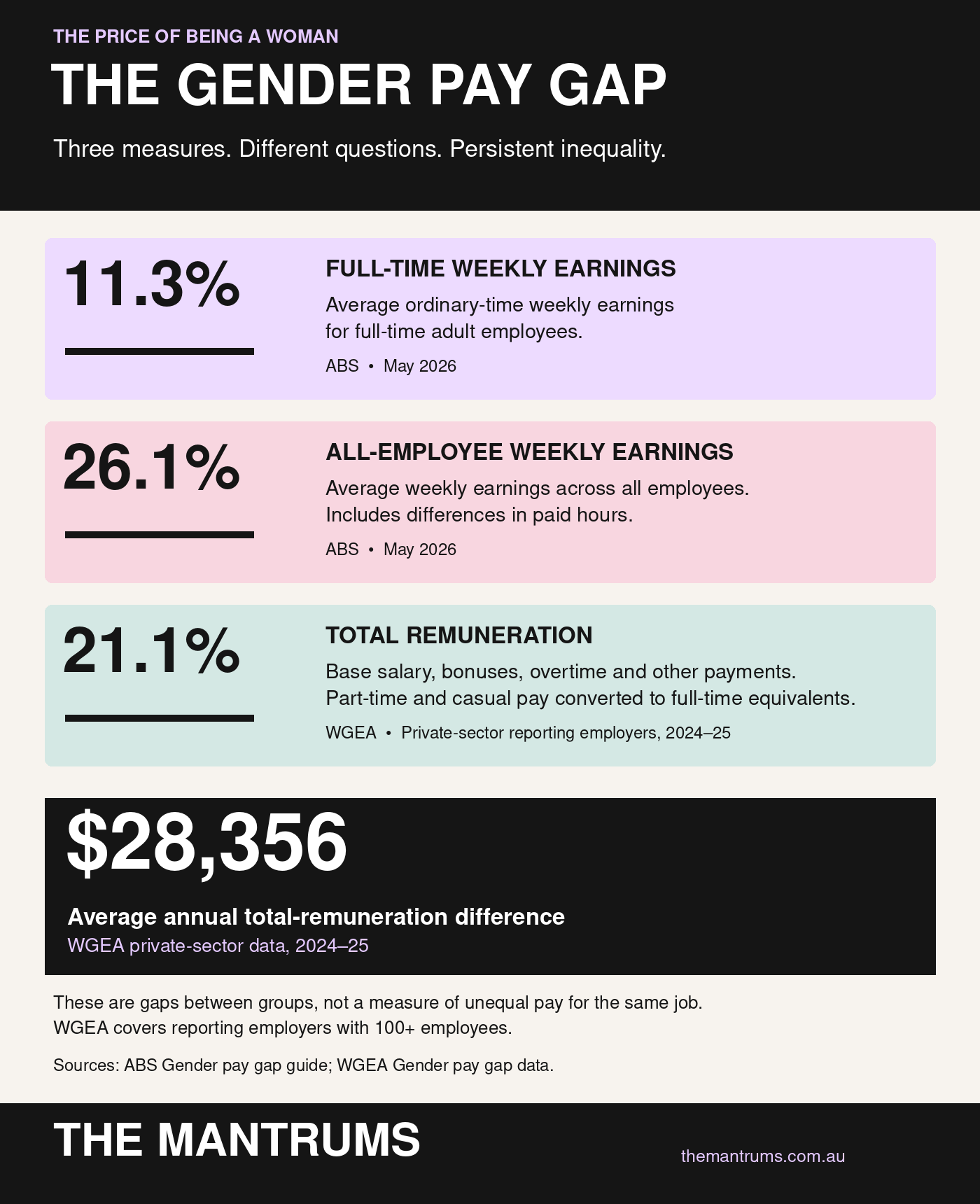
Yes, there’s a gender pay gap. But there isn’t just one measure. In May 2026, the ABS reported an 11.3% gap in average full-time adult ordinary-time weekly earnings. Across all employees, including part-time workers, the average weekly earnings gap was 26.1%. The measures answer different questions: the second also reflects differences in paid hours. Australian Bureau of Statistics
Meanwhile, WGEA’s 2024–25 private-sector employer data puts the average total-remuneration gap at 21.1%—an annual difference of $28,356. That measure includes base salary, overtime, bonuses and other payments, and converts part-time and casual salaries to annualised full-time equivalents. It covers employers with at least 100 employees, not every Australian workplace. National, Industry and Employer information
These numbers don’t mean every woman earns that much less than a man in the same role. They highlight differences between groups. The issue is why these gaps persist. Who takes on unpaid care work? Whose career is put on hold? Who gets promoted or receives bonuses? How do we value jobs where most workers are women?
The gap is getting smaller. WGEA’s total pay gap dropped by 0.7 percentage points from last year. That is a step forward. Still, an average yearly difference of over $28,000 shows there is more work to do. WGEA
Over a lifetime, this inequality affects women’s superannuation. ASFA’s October 2025 analysis found female account holders averaged $154,641, while male account holders averaged $192,119. That is about 19.5% less for women. These numbers average people aged 15 and over, not just those in retirement. They still show a large savings gap. ASFA
Housing insecurity is part of the picture, too. AIHW reports that between March 2018 and March 2026, the number of women aged 50 and over receiving specialist homelessness support while experiencing homelessness almost doubled. That measures service clients, rather than every older woman experiencing homelessness. But it is a much clearer warning than a vague claim about the “fastest-growing group”. Australian Institute of Health and Welfare
Less financial security can mean fewer options when a relationship ends, rent rises or paid work becomes impossible. Equality has to mean something when the bills arrive.
Motherhood has an economic cost
Let’s try a thought experiment. When a couple has a baby, who cuts back on work hours? Who takes most parental leave? Who calls in when their child wakes up sick at 6 a.m.? Whose chance at a promotion slips away?
Treasury research published in 2023, using the HILDA survey and Australian Taxation Office data, found that having children creates an average 55% earnings penalty for women relative to men in the first five years of parenthood. The penalty reflects reduced employment participation and working hours, not a sudden 55% cut to women’s hourly pay. Analysis of tax data showed the gap remained substantial for ten years after children arrived. Treasury.gov.au
Researchers call it the motherhood penalty. Some of us call it a tax on a job description nobody applied for.
There are signs of change. In WGEA’s 2024–25 reporting workplaces, men took 20% of primary or universal parental leave, up three percentage points from the previous year. More fathers taking leave is good news. It also means women still took the overwhelming majority. WGEA
Sharing care more equally requires workplaces, leave policies and household expectations to support it. It shouldn’t depend on a mother absorbing the financial cost by default.
Our bodies, apparently everyone else’s business
Women’s health is where “it’s fine, calm down” goes to die.
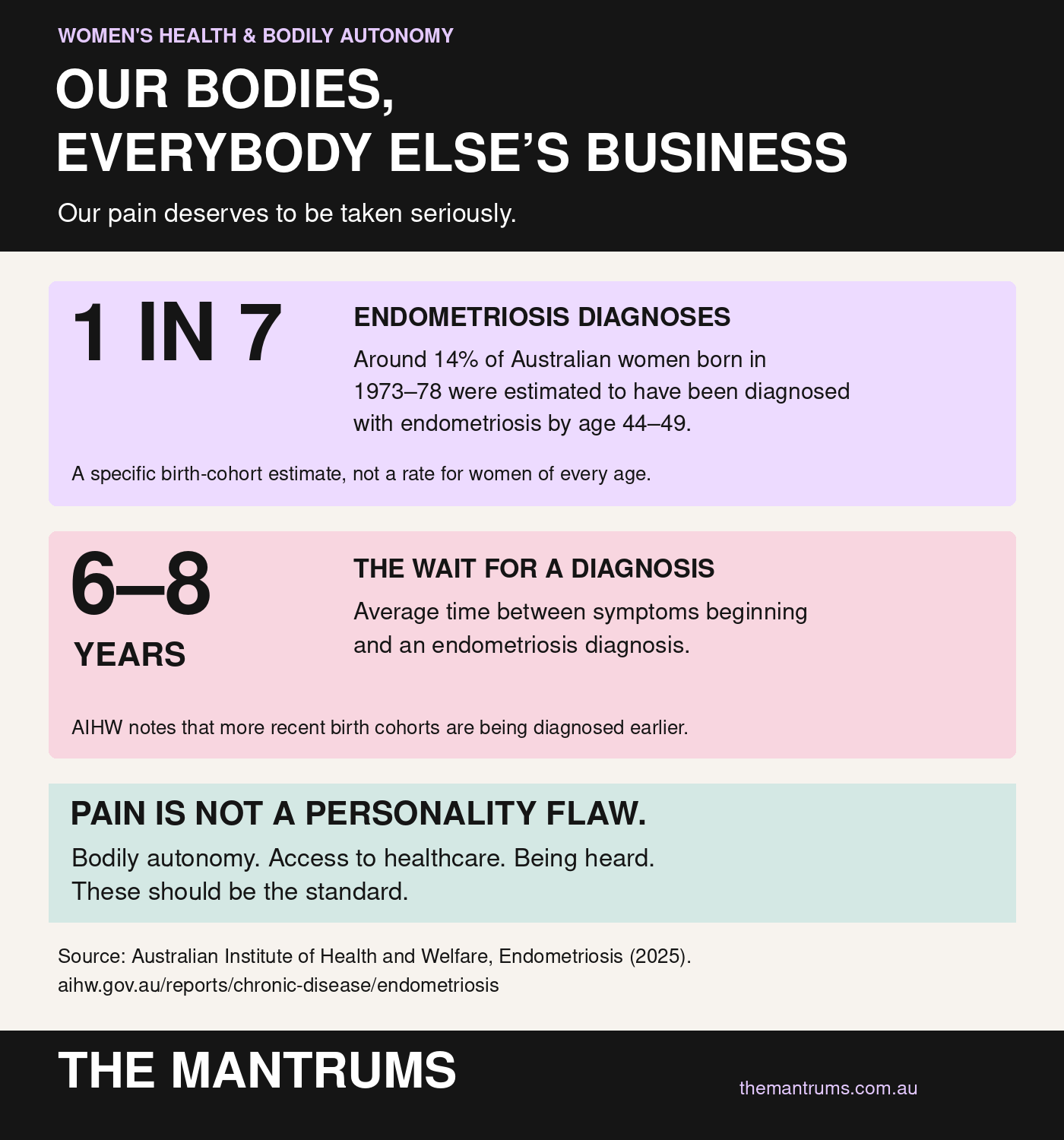
Take endometriosis. AIHW estimates that around one in seven women born in 1973–78 had been diagnosed by age 44–49. That’s an estimate for a particular birth cohort, rather than a claim that exactly one in seven women of every age has the condition. AIHW also reports an average delay of six to eight years between symptoms beginning and diagnosis. Australian Institute of Health and Welfare
Six to eight years. Years in which pain can interfere with school, work, relationships and everyday life before someone finally gets an answer. AIHW notes that more recent birth cohorts are being diagnosed earlier, which may reflect better awareness and recognition. Progress matters here, too. So does the delay that remains. Australian Institute of Health and Welfare
The government’s #EndGenderBias survey documents experiences of barriers and bias in healthcare. It gives women and gender-diverse people a way to describe what being dismissed, disbelieved, or unable to access care actually looks like. Those accounts shouldn’t need to become a national survey before someone listens. health.gov.au
We rely on our bodies to keep us going, but understanding and caring for them often feels like an afterthought. When we speak up about pain, people say it’s normal, accuse us of exaggerating, or claim it’s “all in our heads.” It’s a familiar story.
This goes straight to human rights: bodily autonomy and access to healthcare are not extras. Neither is having your pain taken seriously.
Who does the unpaid work?
Domestic labour has a remarkable talent for disappearing: no invoice, no payslip, no performance review, just cooking, cleaning, childcare, caring for ageing parents, remembering dentist appointments, buying a birthday present for your partner’s mother, and the vast, invisible admin of keeping a household running.
The ABS 2024 Time Use Survey found that 90% of females and 81% of males aged 15 and over did unpaid work on their diary day. Among those who did, females spent an average of four hours and 53 minutes, compared with three hours and 52 minutes for males. That’s an extra hour and a minute a day among participants, including domestic work, childcare, adult care, and volunteering. Australian Bureau of Statistics
For parents with children under 15 who did unpaid work, the difference was larger: female parents spent seven hours and 29 minutes, compared with five hours and 2 minutes for male parents. Australian Bureau of Statistics
These averages describe people who participated in the activities, rather than everyone in the population. The ABS also cautions that changes to the survey limit comparisons with its 2020–21 results. So we shouldn’t use the two surveys to announce that the gap has magically improved or worsened. Australian Bureau of Statistics
The newer figures do show that unpaid work remains unevenly shared. And time is not a neutral resource. Hours spent on unpaid work are hours not spent earning, studying, networking, resting or running for office. Time inequality feeds income inequality, which feeds career stagnation, which feeds poverty in retirement. It’s a very efficient loop.
Power: who actually makes the decisions?
Representation has improved and deserves recognition. At the opening of Australia’s 48th federal Parliament in 2025, women held 49.6% of seats, according to the ABS. This is close to parity and a substantial achievement compared with generations when women were almost entirely shut out.
Australian Bureau of Statistics
But Parliament isn’t every institution. Among employers in WGEA’s 2024–25 dataset, women held 22% of CEO positions, 33% of board seats and 21% of chair roles. Almost a quarter of boards—24%—had no women at all. Those figures reflect WGEA’s reporting employers, not just ASX 200 companies. WGEA
The number of people in the room matters, but so do who leads the meeting, manages the budget, and holds the top position. Parliamentary progress should be acknowledged, but that doesn’t mean power is shared equally elsewhere.
The justice system: a right you have to fight to use
Having a legal right is one thing. Exercising it is another.
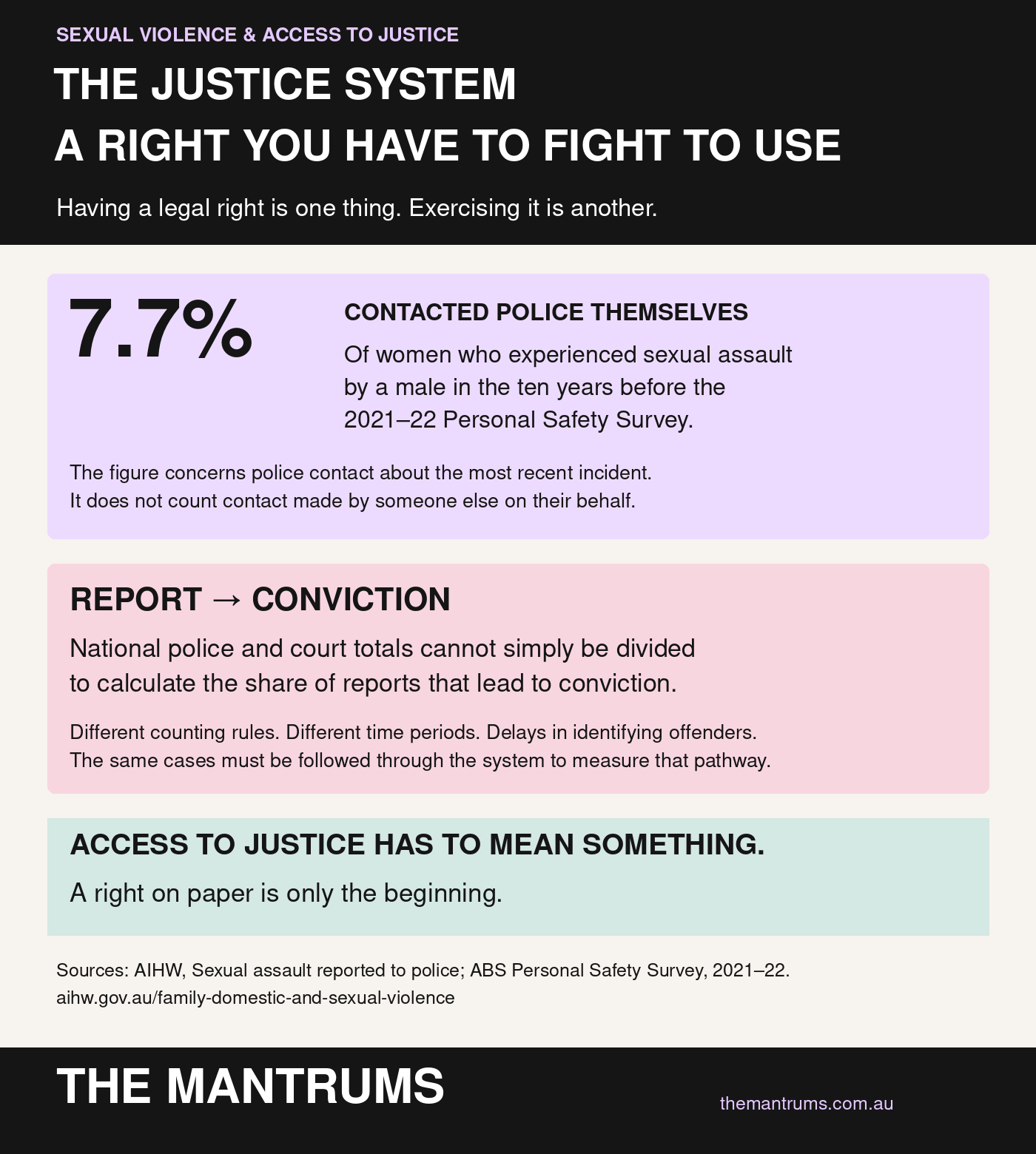
If you report a sexual assault, what are the chances that report ultimately leads to a conviction? We should be able to answer that clearly. But the national figures commonly cited don’t provide a simple, linked measure following the same reports through the entire system. AIHW warns that police-recorded victims, recorded offenders and proceedings use different counting rules and reference periods. Delays can also occur in identifying offenders—or no offender may be identified at all. Australian Institute of Health and Welfare
If you divide a year’s convictions by that year’s recorded victims, you won’t learn what proportion of reports were successful. Instead, you get a number that seems reliable but answers a different question.
What we do know is that only 7.7% of women who experienced sexual assault by a male in the ten years before the 2021–22 survey contacted police themselves about the most recent incident. That doesn’t explain why no woman contacted police. It does tell us that making conduct illegal and ensuring survivors can access justice are very different achievements. Australian Institute of Health and Welfare
And getting into a legal process doesn’t guarantee safety. AIHW’s account of domestic homicide research notes cases in which an abuser manipulated the legal system to exert power over a victim. A system intended to protect someone can become another place they have to defend themselves. Australian Institute of Health and Welfare
So here’s the question: how meaningful is a right if exercising it requires resources, support and endurance that the person harmed may not have?
Not all women experience inequality equally
“Women” is not one homogeneous group, and pretending otherwise lets the system off the hook.
A wealthy white woman in Sydney and a First Nations woman in a remote community are both women. Their exposure to discrimination, violence, poverty, healthcare barriers and contact with state systems can be wildly different. Disability, race, class, sexuality, gender identity, migration status and geography all change the picture. An honest conversation about gender inequality has to account for all those realities, not just the most visible ones.
“But men have problems too”
Absolutely. There’s no denying it. We don’t want to deny it.
Men face issues like suicide, homelessness, violence, workplace deaths, mental illness, and family separation. These are serious. Recognising structural inequality for women does not mean ignoring men’s struggles, and no one is trying to compare who has it worse.
The important question is whether a certain harm is related to gender. Who does it affect? How often does it happen? Who is responsible? In what situations? What social factors play a role? What are the outcomes?
These questions are not about competing. Equality is not about deciding who has the hardest life. Treating it that way only makes it harder for anyone to see real progress.
So, do women really have it that bad in Australia?
Not every woman is oppressed every minute of every day. Australian women have rights that generations of women fought extraordinarily hard to win, and Australia has made genuine progress.
But that’s the wrong benchmark.
We shouldn’t judge women’s equality by asking only whether things could be worse. Instead, we should compare it to the society Australia says it wants to be. A society where your gender does not decide your chances of facing violence, the amount of unpaid work you do, your lifetime earnings, how seriously your pain is treated, your financial security in retirement, or your power.
And if the data consistently shows that it still does, then perhaps women aren’t imagining the inequality. Perhaps we should stop asking whether they really have it that bad, and start asking why we’re still prepared to accept it.
If you or someone you know is affected by domestic, family or sexual violence, 1800RESPECT (1800 737 732) offers free, confidential support 24/7. In an emergency, call 000.