
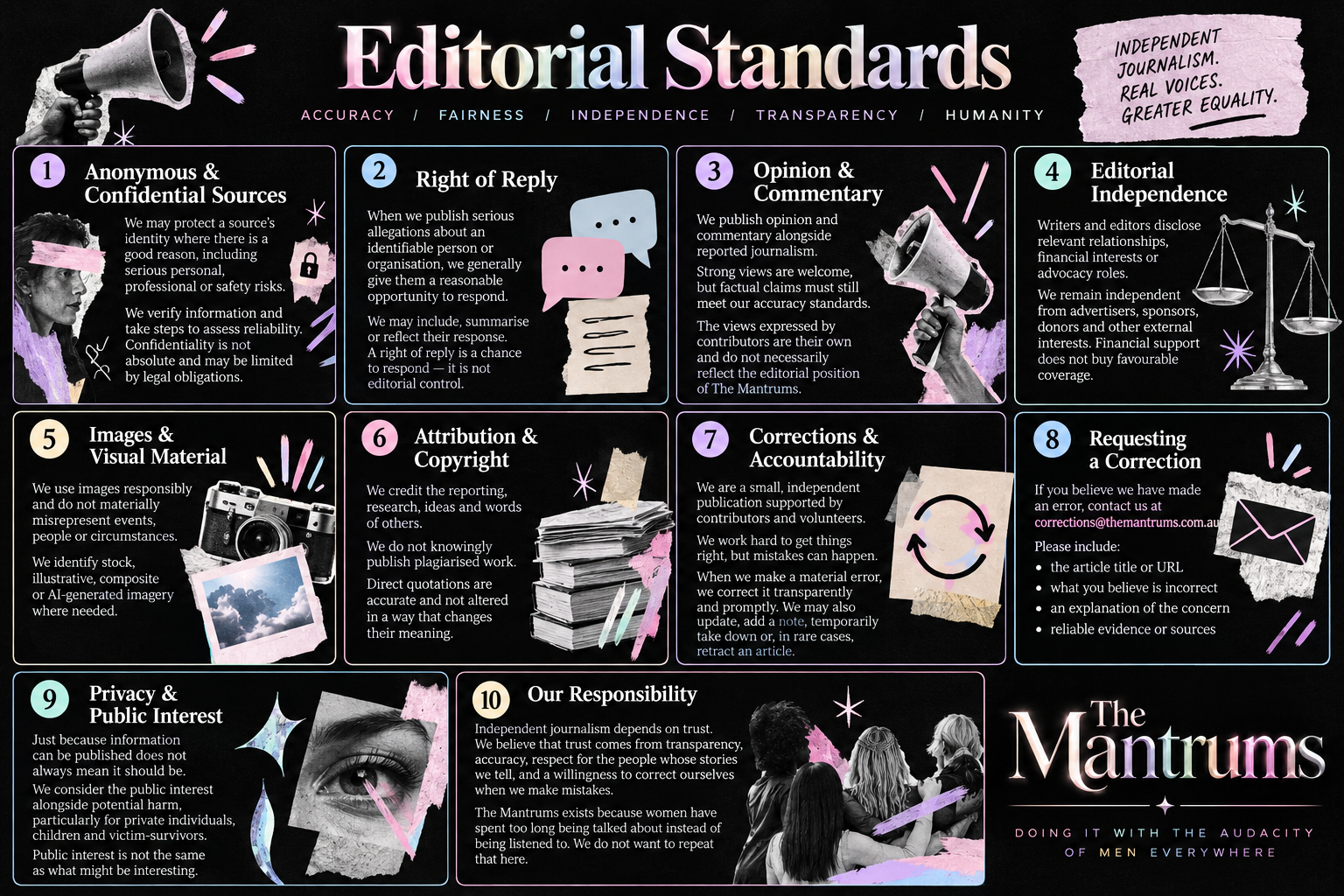
Our journalism is guided by accuracy, fairness, independence, transparency and humanity.
1. Accuracy & Accountability
We aim to: report information accurately and in appropriate context; distinguish clearly between fact, allegation, analysis and opinion; use reliable evidence and sources to support factual claims; and correct material errors promptly and transparently when we get something wrong.
2. Fairness & Independence
We aim to: provide a reasonable opportunity to respond when serious allegations are made about an identifiable person or organisation; maintain editorial independence from advertisers, sponsors, donors and other external interests; and disclose conflicts of interest where they could reasonably affect, or appear to affect, our editorial independence. Fairness does not require us to give every argument equal weight when the available evidence does not support them equally.
3. Humanity & Minimising Harm
We aim to: minimise unnecessary harm, particularly when reporting on trauma, sexual violence, domestic and family violence and other sensitive matters; respect the dignity, autonomy, privacy and safety of victim-survivors; and avoid sensationalising trauma or including invasive detail simply because it attracts attention. Public interest matters. Curiosity alone is not public interest
4. Representation & Challenging Inequality
We aim to: challenge stereotypes, victim-blaming and discriminatory narratives; centre voices that have historically been marginalised or excluded from mainstream reporting; recognise that no individual can speak for an entire community; and give people meaningful opportunities to speak in their own voices rather than unnecessarily translating their experiences into ours. For The Mantrums, representation is not simply about who appears in a story. It is also about who gets to tell it.
The Mantrums welcomes submissions from women and anyone who wants to share their stories in their own words. This difference is important to us. For generations, women have been told how and when to speak, what tone to use, and how to describe their experiences to be credible. We do not want publishing someone’s story to become another way of telling her how to share it. That’s why, for pieces published as In Their Own Words, we take a deliberately light editorial approach.
We might correct spelling, grammar, formatting, or sentence structure as needed for readability. We also work with contributors if there are legal, factual, privacy, safety, or ethical concerns. We will not water down someone’s anger, soften their words, make their experience easier to accept, or change their voice to match ours. If major changes are needed, we will work with the contributor as much as possible instead of just rewriting their story. When we’re done, their story should still sound like them.
First-person stories share a contributor’s own experiences, memories, feelings, and views. Publishing these stories does not mean The Mantrums has checked every detail of someone’s personal experience.
If a submission makes serious factual claims about another identifiable person, we may need extra editorial and legal review. We might ask for supporting material, remove identifying details, seek a response from the person involved, delay publication, or decide not to publish if we can’t manage the risks responsibly. Respecting someone’s voice does not take away our responsibility as a publisher.
If your story involves sensitive, identifying or legally restricted information, contact us before sending documents or detailed evidence so we can discuss a safer way to communicate.
At The Mantrums, we believe journalism should be based on human thought, reporting, experience, and judgment. The stories, opinions, and experiences we publish under our writers’ names reflect their own work and views. We won’t publish articles written entirely by AI under a human byline. And we don’t use generative AI to replace journalism, original reporting, or human experience.
However, we know AI can be helpful. Writers and editors may use AI tools for tasks like proofreading, improving sentence structure, spotting repetition, transcribing, organising research or notes, and making content easier to read or access. For us, the difference is clear. AI can help with how something is written, but it should not decide what we think, what we report, or what someone has experienced.
We don’t treat AI-generated information as a source. We check facts, statistics, quotes, research, legal cases, and other verifiable details against reliable sources before publishing. We don’t allow generative AI to make up quotes, interviews, sources, evidence, people, events, or experiences.
If generative AI has played a significant role in an article or visual content and readers would expect to know, we will inform them about its use. No matter what tools we use, a human is always responsible for the final published work. Editorial responsibility is ours, not an algorithm’s.
We work hard to get things right. Our reporting is based on evidence relevant to the topic, and we check information before publishing. We use primary and trusted sources, like laws, court documents, government data, official reports, peer-reviewed research, original statements, and direct interviews. We also try to link to or name important sources so readers can check the evidence themselves.
We do not claim to know more than the evidence shows. If something is unknown, disputed, or unverified, we make that clear in our reporting.
This matters most when we report on allegations, criminal investigations, and legal cases. An allegation doesn’t mean someone is guilty. We use language that clearly shows what is alleged, what has been proven, and the status of the case when we publish.
When serious allegations involve a person or organisation we can identify, we usually give them a chance to respond before publishing. If they don’t reply, we tell readers we offered them the opportunity. Reporting can change as we learn more. When important new information comes up, we may update an article and, if needed, let readers know what has changed.
If we make a significant mistake, we correct it. You can read more about how we handle errors in our Corrections Policy.
The Mantrums focuses on covering gender-based violence. We understand that the words we use when reporting on violence can either challenge or reinforce harmful myths.
Where relevant, we aim to avoid victim-blaming; avoid implying a victim-survivor was responsible for another person’s violence; avoid unnecessary graphic detail; respect requests for anonymity where reasonably possible; consider whether identifying information could expose a survivor to additional risk; avoid sensationalising violence; provide appropriate context about gender inequality and patterns of violence; use trauma-informed interviewing and reporting practices; and include relevant support services where content may be distressing or directly concerns domestic, family or sexual violence.
How someone acts before or after experiencing trauma never determines whether their experience is believable.
There is no one right way for a victim-survivor to act.
When we report on Aboriginal and Torres Strait Islander peoples and communities, The Mantrums aims to put First Nations voices at the centre, respect cultural protocols, and avoid reporting that removes important historical, structural, or cultural context.
Where appropriate, we seek guidance from Indigenous-led organisations, research and sources rather than relying solely on non-Indigenous interpretations of Indigenous experiences.
We understand that just because someone shares their story with us, it doesn’t mean we own it.
The Mantrums recognises that women are not one homogeneous group.
Gender inequality intersects with race, Indigeneity, disability, sexuality, gender identity, socioeconomic status, migration status, age and other forms of inequality.
Our reporting should show that complexity.
We aim to report respectfully on transgender and gender-diverse people. We also recognise that gender-based violence and patriarchal systems affect people in different ways, depending on their identities and situations.
1800RESPECT
National domestic, family and sexual violence counselling, information and support.
Lifeline
24-hour crisis support and suicide prevention services.
13YARN
Culturally safe crisis support for Aboriginal and Torres Strait Islander people.
The Mantrums is a journalism publication, not a crisis or counselling service. Our inboxes are not monitored continuously and cannot provide emergency assistance.